
Jumbo loans in California finance the homes that cost more than a standard mortgage allows. In a state where prices in many markets run well past a million dollars, jumbo financing isn't exotic, it's everyday, and getting it right can save you real money on a large loan. The catch is that jumbo loans don't follow the same playbook as a conforming mortgage, and the terms vary far more between lenders.

Save Financial is a California-licensed mortgage brokerage, and we arrange jumbo and super-jumbo financing across the state. This guide explains what counts as a jumbo loan, how it differs from a high-balance loan, what it takes to qualify, whether jumbo rates are really higher, and the options available to high-value and high-net-worth buyers.
A jumbo loan is a mortgage that exceeds the conforming loan limit set by the Federal Housing Finance Agency. Because the loan is too large for Fannie Mae or Freddie Mac to buy, it's considered non-conforming, and the lender either keeps it in their own portfolio or sells it to private investors. That single fact shapes everything about jumbo lending.
Without Fannie and Freddie setting the rules, each lender writes its own guidelines for jumbo loans. They decide the credit, down payment, reserve, and documentation requirements, and they price the loans based on their own appetite for high-value mortgages. That's why jumbo terms vary so much from one lender to the next, and why comparing them matters more here than on almost any other loan.
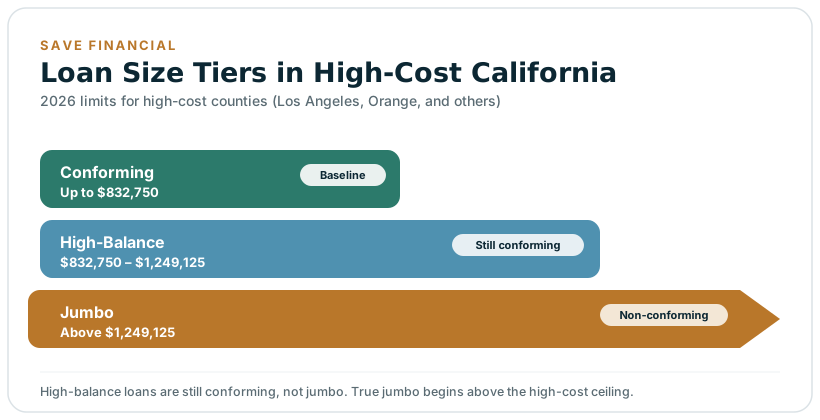
People use these terms loosely, but the distinction affects your loan, so let's make it clear. There are three tiers, and where your loan amount lands determines its category.
| Tier | 2026 loan amount (high-cost California county) | Type |
|---|---|---|
| Conforming (baseline) | Up to $832,750 | Conforming |
| High-balance / super-conforming | $832,750 to $1,249,125 | Conforming (high-balance) |
| Jumbo | Above $1,249,125 | Non-conforming |
Here's the part that surprises people: a high-balance loan is not a jumbo loan. A high-balance, or super-conforming, loan still follows Fannie and Freddie rules and counts as conforming, just with a higher limit allowed in high-cost counties. A true jumbo loan is anything above that high-cost ceiling. In a baseline county, where the conforming limit is $832,750, jumbo territory starts lower. We confirm your county's exact thresholds so you know which tier your loan falls into, because the tier changes your rate and your requirements.
Whether you need a jumbo loan depends entirely on your loan amount and your county. In high-cost coastal and metro counties, you can borrow up to $1,249,125 in 2026 and still stay conforming, so you only reach jumbo territory above that. In lower-cost counties, the conforming line is lower, so jumbo starts sooner.
Because so many California homes price into the millions, a large share of buyers in markets like the coastal communities, the Westside, and the hills end up needing jumbo financing. The good news is that jumbo lending is competitive here precisely because the demand is so high.
Jumbo borrowers here are a broad group, not just the ultra-wealthy. They include move-up buyers purchasing in the millions in coastal and metro markets, professionals and dual-income households whose careers have outpaced the conforming limit, and self-employed business owners with strong but complex finances. Many are buying a primary home in a high-priced area where the median price alone pushes past conforming. Others are high-net-worth buyers with substantial assets but modest reported income who fit asset-based programs well. What they share is a loan amount above the conforming line and a need for a lender that handles large loans smoothly. The right jumbo lender for a salaried executive isn't always the right one for a business owner or a retiree living on investments, which is why matching the borrower to the program matters.
Jumbo loans ask for a stronger financial profile than conforming loans, since the lender carries more risk on a larger, non-guaranteed loan. Requirements vary by lender, but these are the typical ranges.
On credit, jumbo lenders generally want a score of 700 or higher for the best pricing, though some programs go lower. The down payment commonly runs 10 to 20 percent, with larger loans sometimes requiring more. Jumbo lenders pay close attention to cash reserves, often wanting six to twelve months of payments held in reserve after closing, and more on very large loans. They prefer a lower debt-to-income ratio, frequently capping it tighter than conforming loans do. You'll provide full documentation of income and assets, and on very high-value properties, a lender may require two appraisals to confirm the value.
None of this means jumbo is out of reach. It means the file needs to be strong and well-prepared, and that's where we add value, matching you to the lender whose guidelines fit your profile.
Jumbo lending is more varied than people expect, with options for different buyers and goals.
You can choose a fixed-rate or adjustable-rate jumbo loan, just like conforming, with the 30-year fixed and shorter ARMs both common. Some jumbo programs offer an interest-only period, which lowers the early payment and appeals to certain high-income borrowers who want flexibility. For self-employed buyers, bank statement jumbo loans qualify on deposits rather than tax returns. And for high-net-worth buyers, asset-based jumbo programs can qualify you on your liquid assets instead of monthly income, which suits retirees and investors with substantial holdings but modest reported income. Jumbo financing is also available for second homes and investment properties with many lenders, though the terms differ from a primary purchase.
California's coast and mountains draw a lot of second-home buyers, and jumbo financing handles those purchases regularly. A second-home jumbo loan has its own terms, typically a larger down payment and slightly different pricing than a primary residence, since the lender views a second home as a bit more risk. The property still has to qualify as a genuine second home rather than a rental, which affects how it's documented. If you're buying a beach place, a desert retreat, or a mountain cabin as a getaway, we'll line up the jumbo program built for second homes and explain how its terms differ from financing your primary residence.
Jumbo financing isn't only for purchases. If you already own a high-value home, you can refinance a jumbo loan to lower your rate, change your term, or take cash out of your equity. Because jumbo pricing swings with lender appetite, a jumbo refinance can occasionally land a better rate than your original loan even in a similar market, simply because a different lender is hungry for the business. A jumbo cash-out refinance can also free up significant capital on a high-value property, useful for a remodel, another purchase, or consolidating debt. As with a purchase, we run the break-even math so you only refinance when the numbers genuinely favor it.
This is the question everyone asks, and the honest answer is: not always. There have been stretches where jumbo rates ran below conforming rates, because lenders compete hard for high-value, high-net-worth clients they hope to keep as long-term customers. At other times jumbo rates sit a little above conforming. It moves with the market and with each lender's appetite.
What's consistent is that jumbo pricing varies widely between lenders at any given moment. One lender may be eager for jumbo business and price aggressively while another pulls back. That spread is exactly why shopping jumbo loans across many lenders, which is what a broker does, tends to save high-value borrowers the most.
Pros. Finances high-value homes that conforming loans can't reach. Competitive rates, sometimes better than conforming. Flexible options including interest-only, bank statement, and asset-based programs. Available for primary, second, and investment properties with many lenders. No mortgage insurance on many jumbo programs even below 20 percent down with strong credit.
Cons. Stricter credit, reserve, and documentation requirements. Larger down payments on many programs. Pricing that varies widely, so a single quote tells you little. And on very large loans, extra steps like a second appraisal that can add time.
Jumbo costs scale with the size of the loan. The down payment is typically 10 to 20 percent or more, which on a high-value home is a significant sum. Reserves of several months to a year of payments are usually required, held after closing. Closing costs run the usual range of roughly 2 to 5 percent of the loan amount, which is a large dollar figure on a jumbo loan, so even small differences in lender fees matter. We give you a clear written estimate up front and compare lenders so you're not overpaying on a big loan.
A jumbo purchase follows the familiar path with extra diligence. We start with a pre-approval, reviewing your income, assets, credit, and reserves, and issuing a letter that high-end sellers take seriously. You find a home and make an offer, lock your rate, and we order the appraisal, or two appraisals on very high-value properties. The loan moves through processing and underwriting, which tends to be more thorough on jumbo files, and once it's approved with conditions met, you get a clear-to-close, sign, and the loan funds.
Jumbo loans can take a little longer than conforming, often 30 to 45 days, with very large or complex files sometimes longer. Responsive document handling keeps things moving.
A few errors cost high-value buyers money.
The biggest is taking a single jumbo quote, when jumbo pricing varies so much between lenders that one quote tells you almost nothing. Some buyers assume jumbo rates are automatically higher and don't shop, missing competitive pricing. Others underestimate the reserve requirement, focusing on the down payment and getting caught short. Some confuse a high-balance loan with a jumbo loan and misjudge their tier and pricing. And a few overlook asset-based or bank statement jumbo options that would have qualified them more easily. We help you sidestep all of these.
What is a jumbo loan in California? A jumbo loan is a mortgage that exceeds the conforming limit, which in high-cost California counties is $1,249,125 for 2026. Because it's too large for Fannie Mae or Freddie Mac, lenders set their own guidelines, so terms vary between them.
Is a high-balance loan the same as a jumbo loan? No. A high-balance, or super-conforming, loan still follows Fannie and Freddie rules and counts as conforming, just with a higher limit in high-cost counties. A jumbo loan is above that ceiling and is non-conforming.
What credit score do I need for a jumbo loan? Jumbo lenders generally want a 700 or higher score for the best pricing, though some programs accept lower. Requirements vary by lender, which is why comparing them helps.
How much down do I need for a jumbo loan? Often 10 to 20 percent, with larger loans sometimes requiring more. Some programs allow less for very strong borrowers, and many jumbo loans avoid mortgage insurance even below 20 percent down.
Are jumbo loan rates higher than conventional? Not always. Jumbo rates have sometimes run below conforming because lenders compete for high-value clients. Pricing varies widely between lenders, so shopping is where the savings live.
Can self-employed buyers get a jumbo loan? Yes. Bank statement jumbo loans qualify on deposits, and asset-based jumbo programs qualify on your liquid holdings, both well suited to self-employed and high-net-worth buyers.
Do jumbo loans require reserves? Yes, usually. Lenders often want six to twelve months of payments held in reserve after closing, more on very large loans.
How long does a jumbo loan take to close? Often 30 to 45 days, sometimes longer on very large or complex files, partly because a second appraisal may be required on high-value homes.
Can I use a jumbo loan for a second home? Yes. Jumbo financing is available for second homes and vacation properties with many lenders, typically with a larger down payment and slightly different terms than a primary residence. The property must qualify as a genuine second home rather than a rental.
Jumbo loans reward shopping more than any other loan type, because lenders set their own guidelines and price based on their appetite, which swings widely. On a large loan, even a small rate difference is real money over time. We compare jumbo and super-jumbo lenders across California, including bank statement and asset-based programs for self-employed and high-net-worth buyers, and match you to the one that fits your profile and prices it best.
Our approach is education first. We explain the tier your loan falls into, the reserve and documentation requirements, and your program options in plain language, then lay the choices out side by side. You're welcome to verify our license on NMLS Consumer Access (NMLS #377740, DRE #01875766) before we begin.
Newport Beach (headquarters) Save Financial 4000 MacArthur Blvd, Suite 600 Newport Beach, CA 92660 (949) 379-5320
Marina del Rey Save Financial 13763 Fiji Way, Suite EU2 Marina del Rey, CA 90292 (310) 759-4757
On a large loan, comparing lenders is the difference between a good deal and an expensive one. Tell us the property, your down payment, and your financial picture, and we'll shop jumbo lenders across California and show you the strongest terms in plain numbers.
If you're financing a high-value home anywhere in California, reach out to Save Financial. As a California brokerage that arranges jumbo and super-jumbo loans across many lenders, we'll find the program that fits your purchase and prices it sharply. Call our Newport Beach office at (949) 379-5320 or request a quote to get started.
Loan programs, interest rates, fees, terms, and eligibility requirements are subject to change without notice and depend on borrower qualifications and lender approval. Save Financial is a California-licensed mortgage brokerage (NMLS #377740, DRE #01875766). Equal Housing Opportunity.
Save Financial is a California-licensed mortgage brokerage (NMLS #377740, DRE #01875766) with offices in Newport Beach and Marina del Rey. Call (888) 703-1840 or request your free rate quote. Rates and terms are subject to change and depend on borrower qualifications and lender approval. Equal Housing Opportunity.