
Buying your first home in California can feel out of reach, especially when you look at the prices. The good news is that the path is more open than most people believe. As a first-time home buyer in California, you have access to low down payment loans, assistance programs that help with the cash, and lenders who will explain every step in plain language. You don't need a fortune saved and you don't need perfect credit. You need a plan.

Save Financial is a California-licensed mortgage brokerage, and we walk first-time buyers through this all the time, without pressure and without jargon. This guide covers what counts as a first-time buyer, the loan options, the help available for your down payment, how much money you actually need, and the steps from start to keys.
You might qualify as a first-time buyer even if you've owned a home before. Most programs define a first-time buyer as someone who hasn't owned a primary residence in the past three years. So if you sold a home years ago, or you owned property that wasn't your main home, you may still count. That matters because first-time buyer programs often come with perks, like down payment help or more flexible terms, that you don't want to miss because you assumed you didn't qualify.
If you're not sure where you stand, we'll check it for you. It's a quick question with a meaningful answer.
This is the belief that keeps the most people renting longer than they need to. You do not need to put 20 percent down to buy a home. Twenty percent helps you avoid mortgage insurance, but plenty of strong loan programs let you buy with far less.
Some conventional loans for first-time buyers allow as little as 3 percent down. FHA loans, a favorite for first-time buyers, ask for just 3.5 percent. VA loans let eligible veterans buy with nothing down, and USDA loans offer zero down in qualifying rural and suburban areas. On a real California purchase, that's the difference between needing six figures up front and needing a fraction of it. Once you see the actual numbers for your situation, homeownership often looks closer than you expected.
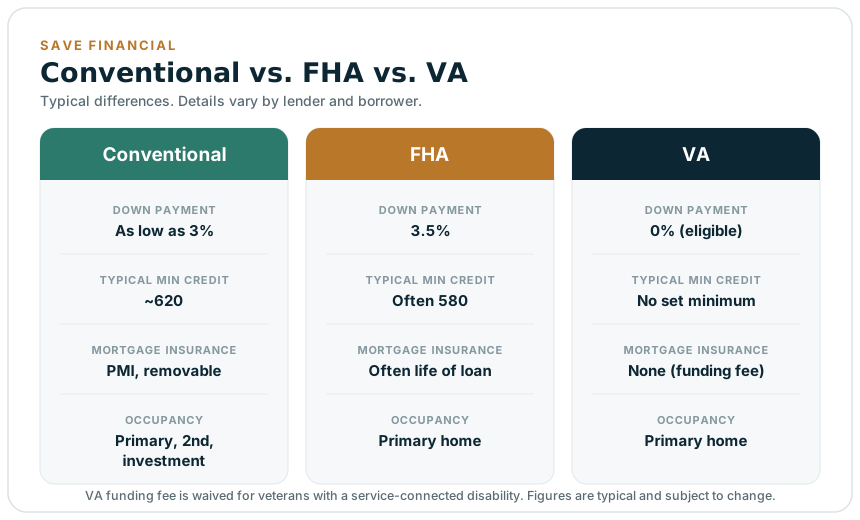
A few programs do most of the work for first-time buyers in California.
A conventional loan with a low down payment suits buyers with decent credit and steady income. Some first-time buyer versions go as low as 3 percent down, and once you reach 20 percent equity, the mortgage insurance can come off.
An FHA loan is built for first-time buyers and those still building credit. With 3.5 percent down and flexible credit requirements, it's often the most accessible path to a first home. It does carry mortgage insurance, so we'll compare it against a low-down conventional loan to see which costs less for you.
A VA loan is one of the best deals in lending for those who've earned it: no down payment, no monthly mortgage insurance, and strong rates for eligible veterans, active-duty members, and certain surviving spouses.
A USDA loan offers zero down in eligible rural and suburban areas, which can include parts of California farther from the major metros.
The right one depends on your service history, your credit, your savings, and where you're buying. We'll match you to the program that fits rather than pushing a single product.
Here's where a lot of first-time buyers find their breakthrough. California offers programs to help with the down payment and closing costs, and using them well can shrink the cash you need to get in the door.
The California Housing Finance Agency, known as CalHFA, runs several programs and assistance options for eligible first-time buyers, including help with the down payment. Many cities and counties offer their own assistance programs and grants on top of that. These programs have income limits, eligibility rules, and funding that changes over time, sometimes opening and closing as money is allocated, so the key is checking what's currently available when you're ready to buy. We stay on top of these and will point you to the programs you actually qualify for.
There's another source of help people overlook: gift funds. Most loan programs let a family member gift you money toward your down payment and closing costs on a primary home, with the right documentation. Between low-down loans, assistance programs, and gift funds, the upfront cash can come together in ways that surprise people.
Let's put real structure on it, because vague numbers cause more anxiety than the truth. You'll generally need three things: a down payment, closing costs, and a small cushion.
The down payment depends on your loan, from zero on a VA loan to 3 or 3.5 percent on conventional and FHA. On a $600,000 home, 3.5 percent is $21,000. Closing costs in California run roughly 2 to 5 percent of the loan amount, covering the appraisal, title, escrow, and lender fees, though a seller credit, a lender credit, or assistance funds can cover part or all of these. A small cash cushion after closing is wise, and some loans require a couple months of payments in reserve.
That total is real money, but it's a long way from the 20 percent figure most people fear, and assistance programs and credits can bring it down further. We'll build your exact numbers so you're working toward a target you can actually see.
You don't need flawless credit to buy your first home. Conventional loans generally start around a 620 score, FHA can go lower, often to 580 with 3.5 percent down, and VA has no firm minimum, though most lenders look for 580 or above. A higher score earns a better rate, but a modest score doesn't shut the door.
Lenders also look at your income and your debt-to-income ratio, which compares your monthly debts, including the new mortgage, to your gross income. Most programs want that under roughly 43 to 50 percent. If your credit or your ratios are tight, that's a conversation, not a dead end. Sometimes a few months of small moves, paying down a card or correcting a credit error, changes your rate or your approval entirely, and we're glad to map that out before you apply.
A little preparation makes the whole journey smoother. Pull your credit so you know your starting point, and if anything looks wrong, dispute it early, since corrections take time. Keep your spending steady and avoid opening new credit or financing big purchases, because lenders look closely at recent debt. Start gathering the documents you'll need, like recent pay stubs, two years of W-2s or tax returns, and bank statements, so you're not scrambling later. Build your savings toward your down payment and a small cushion, and resist moving large sums between accounts right before you apply, which lenders have to question. Some assistance programs also ask first-time buyers to complete a short homebuyer education course, which is worth doing early if it applies. None of this is complicated, and we'll give you a clear checklist so you know exactly what to do.
Here's the whole path, so it feels like a process instead of a mystery.
First, figure out your budget and get pre-approved. We review your income, savings, and credit and tell you what you can comfortably borrow, then issue a pre-approval letter. This is your shopping license, and a real underwriter-reviewed pre-approval carries far more weight than an online estimate.
Next, find a real estate agent and start looking. Your agent helps you find homes in your range and write offers. We're available to talk to listing agents to back up your pre-approval, which helps your offer stand out.
When you find the home, make an offer. Once it's accepted, you'll have an inspection period to check the home's condition, and we'll order the appraisal to confirm the value. You'll lock your interest rate around this point.
Then the loan goes through processing and underwriting, where we verify your documents and the lender reviews everything. Answer document requests quickly here, because your speed is the biggest thing you control. Once the loan is approved with conditions met, you get a clear-to-close.
Finally, you close. You sign with a notary, your down payment and closing funds are handled through escrow, the loan funds, and the home is yours. We're with you through all of it.
California is expensive, and pretending otherwise helps no one. For a first-time buyer, the high prices mean you may need to be strategic, and there are good strategies.
Many first-time buyers start with a condo or townhome, which costs less than a single-family home and gets you building equity. Others house-hack, buying a duplex or fourplex with a low-down FHA or VA loan, living in one unit and renting the others so the tenants help cover the mortgage. Some buyers look a little farther from the priciest metros, where the same budget stretches further. And nearly everyone benefits from combining a low-down loan with assistance programs and gift funds to lower the cash needed.
There's no shame in starting smaller or in a different area than your dream home. The point is to get on the ladder. Equity tends to build over time in California, and your first home is usually a step toward your next one, not your forever decision.
A few avoidable errors trip up new buyers.
The most common is shopping for homes before getting pre-approved, then falling for a place you can't yet make an offer on, or losing it to a buyer who was ready. Get pre-approved first. Another is assuming you need 20 percent down and waiting years longer than necessary to save it. Many buyers also forget to budget for closing costs and the small cushion beyond the down payment, then feel squeezed at the end. Some open new credit, financing a car or furniture, right before closing, which can change their approval at the worst moment. And plenty take the first loan offer they see, when comparing lenders, which a broker does for you, often saves real money on the biggest purchase of their life.
We help you sidestep every one of these.
Who qualifies as a first-time home buyer in California? Most programs define a first-time buyer as someone who hasn't owned a primary residence in the past three years, so you may qualify even if you owned a home before. Many first-time buyer programs come with down payment help or flexible terms.
How much do I need for a down payment in California? Less than you think. Some conventional loans allow 3 percent down, FHA asks for 3.5 percent, and VA can be zero down for eligible veterans. Assistance programs and gift funds can lower the cash you need further.
Do I need perfect credit to buy my first home? No. Conventional loans generally start around 620, FHA can go to 580 with 3.5 percent down, and VA has no firm minimum. A higher score earns a better rate, but a modest score doesn't rule you out.
What is down payment assistance and can I use it in California? Down payment assistance helps cover your down payment or closing costs through state and local programs. CalHFA and many cities offer options for eligible first-time buyers, with income limits and funding that change over time, so we'll point you to what's currently available.
Can I use gift money for my down payment? Yes. Most loan programs allow a family member to gift funds toward your down payment and closing costs on a primary home, with proper documentation.
What loan is best for a first-time buyer? It depends on your situation. FHA is popular for its low 3.5 percent down and flexible credit, conventional works well with decent credit, and VA is the strongest option for eligible veterans. We compare them for you.
How much are closing costs for a first-time buyer? Generally 2 to 5 percent of the loan amount, though a seller credit, lender credit, or assistance funds can cover part or all of them.
How long does it take to buy a first home? Once your offer is accepted, a typical purchase closes in 30 to 45 days. Getting pre-approved first and responding to document requests quickly keeps things moving.
First-time buying is where good guidance matters most, because you haven't done this before and the stakes feel huge. We slow down, explain everything in plain language, and answer every question without making you feel rushed or small. We also compare many lenders and stay current on California's assistance programs, so we can build the combination of loan, credits, and help that gets you into a home with the least strain.
Our approach is education first, sell second. We'll tell you honestly if you're better off waiting a few months to strengthen your file, and we'll celebrate with you when the timing is right. You're welcome to verify our license on NMLS Consumer Access (NMLS #377740, DRE #01875766) before we begin.
Newport Beach (headquarters) Save Financial 4000 MacArthur Blvd, Suite 600 Newport Beach, CA 92660 (949) 379-5320
Marina del Rey Save Financial 13763 Fiji Way, Suite EU2 Marina del Rey, CA 90292 (310) 759-4757
You don't have to have it all figured out to start. The best first move is a conversation and a pre-approval, so you know your real budget and what help you qualify for before you ever look at a listing.
If you're ready to buy your first home anywhere in California, reach out to Save Financial. As a California brokerage that guides first-time buyers through every step, we'll review your situation, find the programs that fit, and lay out a clear plan in plain numbers. Call our Newport Beach office at (949) 379-5320 or request your free pre-approval, and let's get started.
Loan programs, interest rates, fees, terms, and eligibility requirements are subject to change without notice and depend on borrower qualifications and lender approval. Down payment assistance programs have their own eligibility rules and limited funding. Save Financial is a California-licensed mortgage brokerage (NMLS #377740, DRE #01875766). Equal Housing Opportunity.
Save Financial is a California-licensed mortgage brokerage (NMLS #377740, DRE #01875766) with offices in Newport Beach and Marina del Rey. Call (888) 703-1840 or request your free rate quote. Rates and terms are subject to change and depend on borrower qualifications and lender approval. Equal Housing Opportunity.