
FHA loans in California open the door to homeownership for buyers who don't have a big down payment or a perfect credit score. With as little as 3.5 percent down and more forgiving credit requirements than most conventional loans, an FHA loan is often the most accessible path to a first home, especially in a high-priced state. The trade-off is mortgage insurance, and understanding how that works is the key to deciding whether FHA is right for you.
Save Financial is a California-licensed mortgage brokerage, and we help buyers weigh FHA against the alternatives every week. This guide explains how FHA loans work, the 2026 California limits, the mortgage insurance rules that confuse so many people, and how FHA stacks up against a conventional loan.
An FHA loan is a mortgage insured by the Federal Housing Administration and issued by an approved lender. The government doesn't lend the money. It insures the loan, which lowers the lender's risk and lets them approve buyers who might not qualify for conventional financing. That insurance is why FHA loans can offer low down payments and accept lower credit scores.
FHA loans are for owner-occupied homes only, meaning you have to live in the property as your primary residence. You can buy a single-family home, a condo in an FHA-approved project, or a 2 to 4 unit property as long as you occupy one of the units. That last option is popular with buyers who want to live in one unit and rent the others.
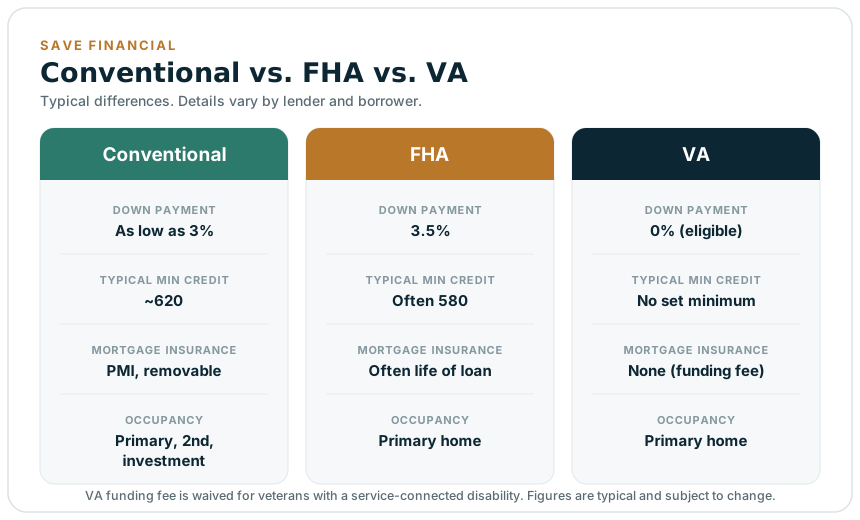
FHA financing fits a clear set of buyers.
It's a strong choice for first-time buyers who haven't saved a large down payment, and for anyone whose credit is still recovering from past bumps. It works well for buyers with a higher debt-to-income ratio, since FHA guidelines are more flexible there than conventional loans. And it's a smart tool for house-hackers buying a 2 to 4 unit property to live in and rent out, because the low down payment applies to multi-unit purchases too.
If you have strong credit and a 20 percent down payment, a conventional loan may serve you better by avoiding mortgage insurance. We'll compare both honestly so you don't pay for insurance you don't need.
FHA guidelines are set federally, with some lender-specific overlays. Here's what to expect.
The down payment is 3.5 percent for buyers with a credit score of 580 or higher. If your score falls between 500 and 579, FHA still allows a loan with 10 percent down, though many lenders set their own minimums higher. On credit, FHA's official floor is 580 for the low down payment, but lender overlays often look for 600 to 620, and we'll match you to a lender whose standards fit your profile.
FHA is generous on the debt-to-income ratio, often allowing higher ratios than conventional with compensating factors like reserves or a strong payment history. You'll need to document income the usual way, with pay stubs and tax forms, or bank statements on certain programs if you're self-employed. The property must be your primary residence, and gift funds from family are allowed toward your down payment and closing costs.
One thing FHA buyers should know: the appraisal holds the home to minimum property standards for health and safety. The appraiser checks that the home is safe, sound, and secure, so a property in rough condition may need repairs before the loan can close. We flag this early on fixer-style homes.
FHA sets a limit on how much you can borrow, and it varies by county based on local home prices. Here's where California stands for 2026.
| County tier | 2026 FHA limit (1-unit) | Examples |
|---|---|---|
| Floor (lower-cost counties) | $541,287 | Many inland counties |
| Ceiling (high-cost counties) | $1,249,125 | Los Angeles, Orange, and other coastal metros |
Higher limits apply to 2 to 4 unit properties. In California's high-cost counties, the FHA ceiling matches the conforming high-balance limit, which means FHA can finance a sizable home here with just 3.5 percent down. We confirm the exact limit for your county before you write an offer.
This is the part that trips people up, so let's make it clear. FHA loans carry mortgage insurance in two parts.
The first is an upfront mortgage insurance premium of 1.75 percent of the loan amount. Most buyers finance this into the loan rather than paying it in cash, so it adds a little to the balance. The second is an annual mortgage insurance premium, paid monthly as part of your payment. The annual rate depends on your loan term and how much you put down.
The detail that matters most is how long the annual premium lasts. On most FHA loans with less than 10 percent down, the annual mortgage insurance stays for the life of the loan. Put 10 percent or more down, and it drops off after 11 years. Because most FHA buyers put down the minimum, their mortgage insurance is effectively permanent, which is the main reason to compare FHA against conventional.
So how do you get rid of it? The common path is to refinance into a conventional loan once your home has appreciated and you've built enough equity, usually 20 percent. In California's rising-value markets, that refinance can become possible sooner than you'd think, and it can cut both your rate and your insurance at once.
Both are great loans. The right one depends on your credit, your down payment, and your timeline.
| FHA loan | Conventional loan | |
|---|---|---|
| Down payment | 3.5% with 580+ credit | As low as 3% |
| Minimum credit | 580 for 3.5% down | Around 620 |
| Mortgage insurance | Upfront plus annual, often for the life of the loan | PMI, removable at 20% equity |
| Occupancy | Primary residence only | Primary, second, or investment |
| Best for | Lower credit or higher DTI | Stronger credit and lower DTI |
The short version: FHA usually wins when your credit is lower or your debt-to-income is tight, because it's more forgiving. Conventional usually wins when your credit is solid, because you can drop the mortgage insurance later. Many buyers start with FHA and refinance to conventional once their equity and credit improve. We'll lay out both paths in plain numbers.
FHA is more than one product. A standard FHA purchase loan is the most common, but there are others worth knowing.
The FHA 203(k) renovation loan lets you finance the purchase price and the cost of repairs or improvements in a single loan, which is useful for a home that needs work before it meets FHA's property standards or your own. The FHA Streamline Refinance is a simplified way for existing FHA borrowers to lower their rate with reduced paperwork and, in many cases, no new appraisal. And FHA's 2 to 4 unit financing lets owner-occupants buy small multifamily with the same low down payment, turning a first purchase into an income property.
Condos are a common entry point in California, but FHA financing on a condo has an extra step. The condo project usually has to be FHA-approved, meaning HUD has reviewed the homeowners association's finances, insurance, owner-occupancy mix, and other factors. If the whole project isn't approved, FHA also offers single-unit approval, which lets a lender approve one unit in an otherwise unapproved building under certain conditions. Either way, the building matters as much as your file. We check a condo project's FHA status early, before you fall for a specific unit, so you know whether FHA will work there or whether a conventional loan is the better route for that purchase. In a state with this many condos, that one check saves a lot of disappointment.
Pros. Low 3.5 percent down payment. Flexible credit, accepting scores conventional loans often reject. Higher allowable debt-to-income. Gift funds allowed. High California loan limits in coastal counties. FHA loans are also assumable, which can be valuable to a future buyer if rates rise.
Cons. Mortgage insurance that's often permanent on low-down loans, removable only by refinancing. Primary residence only, so no second homes or pure investments. Property condition standards that can complicate a fixer purchase. And loan limits that, while high in coastal California, can fall short of the priciest homes.
Your FHA costs come in a few layers. The down payment is 3.5 percent for most buyers. The upfront mortgage insurance of 1.75 percent is usually financed into the loan. The annual mortgage insurance is built into your monthly payment. And closing costs run the usual California range of roughly 2 to 5 percent of the loan amount, though a seller credit, lender credit, or down payment assistance can cover part of them. We give you a clear written estimate so you see the full picture before you commit.
An FHA purchase follows the standard path with a couple of FHA-specific steps.
We start with a pre-approval, reviewing your income, assets, and credit and issuing a letter that shows what you can borrow. You find a home and make an offer, and we order the FHA appraisal, which both values the home and checks it against FHA's property standards. The loan moves through processing and underwriting, where we verify your documents and the lender reviews everything, including any repair conditions from the appraisal. Once the loan is approved and conditions are met, you get a clear-to-close, sign with a notary, and the loan funds.
Most FHA purchases close in about 30 to 45 days, and a clean file can move faster.
A few errors come up often.
Many buyers choose FHA without comparing conventional, then carry permanent mortgage insurance they could have avoided with a slightly different loan. Some fall for a fixer-upper without realizing FHA's property standards may require repairs first, when a 203(k) renovation loan would have fit better. Others forget that the upfront mortgage insurance adds to the loan balance, or that lender credit overlays may set a higher score bar than FHA's official minimum. And plenty take the first FHA quote, when pricing and overlays vary between lenders and a comparison saves money.
We help you avoid each of these by comparing your real options up front.
What credit score do I need for an FHA loan in California? FHA's official minimum is 580 for a 3.5 percent down payment, and 500 to 579 with 10 percent down. Many lenders set their own minimums higher, often 600 to 620, so we match you to a lender whose standards fit your score.
How much down do I need for an FHA loan? 3.5 percent with a credit score of 580 or higher. Gift funds from family are allowed, so the down payment doesn't all have to come from your own savings.
What are the 2026 FHA loan limits in California? The 2026 FHA floor is $541,287 in lower-cost counties, rising to a ceiling of $1,249,125 in high-cost counties like Los Angeles and Orange. Higher limits apply to 2 to 4 unit properties.
Does FHA mortgage insurance ever go away? On most FHA loans with less than 10 percent down, the annual mortgage insurance stays for the life of the loan. With 10 percent or more down, it drops after 11 years. The common way to remove it is to refinance into a conventional loan once you have enough equity.
Can I use an FHA loan for an investment property? No. FHA loans are for primary residences only. You can, however, buy a 2 to 4 unit property and rent the other units as long as you live in one of them.
Is an FHA loan better than conventional? It depends. FHA is usually better for lower credit or a higher debt-to-income ratio, while conventional is better with strong credit because you can remove the mortgage insurance. We compare both for your situation.
Can I buy a fixer-upper with an FHA loan? Sometimes a standard FHA loan works, but if the home needs significant repairs to meet FHA's property standards, an FHA 203(k) renovation loan that finances the repairs may be the better fit.
How long does an FHA loan take to close? Most FHA purchases close in about 30 to 45 days, similar to a conventional loan, with a clean file sometimes closing faster.
FHA lender overlays vary widely. One lender wants a 620 score where FHA's rule says 580, another treats self-employed income differently, and pricing differs across the board. Shopping those differences is where buyers save, and that's exactly what a broker does. We compare FHA lenders across California and, just as important, weigh FHA against conventional so you don't carry permanent mortgage insurance you didn't need.
Our approach is education first. We explain the mortgage insurance rules clearly, lay your options out side by side, and let you decide without pressure. Responsible lending guides what we recommend. You're welcome to verify our license on NMLS Consumer Access (NMLS #377740, DRE #01875766) before we begin.
Newport Beach (headquarters) Save Financial 4000 MacArthur Blvd, Suite 600 Newport Beach, CA 92660 (949) 379-5320
Marina del Rey Save Financial 13763 Fiji Way, Suite EU2 Marina del Rey, CA 90292 (310) 759-4757
The best way to know whether an FHA loan fits is to compare it against your other options on your actual numbers. Tell us your credit, your savings, and your budget, and we'll show you FHA and conventional side by side, with the real monthly cost of each.
If you're buying a home anywhere in California, reach out to Save Financial. As a California brokerage that shops FHA and conventional loans across many lenders, we'll find the program that fits you best. Call our Newport Beach office at (949) 379-5320 or request your free pre-approval to get started.
Loan programs, interest rates, fees, terms, and eligibility requirements are subject to change without notice and depend on borrower qualifications and lender approval. FHA loans require mortgage insurance. Save Financial is a California-licensed mortgage brokerage (NMLS #377740, DRE #01875766). Equal Housing Opportunity.
Save Financial is a California-licensed mortgage brokerage (NMLS #377740, DRE #01875766) with offices in Newport Beach and Marina del Rey. Call (888) 703-1840 or request your free rate quote. Rates and terms are subject to change and depend on borrower qualifications and lender approval. Equal Housing Opportunity.