
Investment property loans in California come in more varieties than most buyers expect, and picking the right one can mean the difference between a deal that pencils and one that doesn't. A conventional loan, a DSCR loan, a bank statement loan, and a portfolio loan all finance rentals, but they qualify you differently, price differently, and suit different investors. Choosing well starts with knowing the menu.

Save Financial is a California-licensed mortgage brokerage that works with investors across the state, from a first duplex to a growing portfolio. This guide lays out every way to finance an investment property in California, how to choose between them, what you'll need to qualify, and the local realities, from cash flow to rent control, that shape an investor's returns here.
Investors here come in every size. Some are first-timers buying a single rental or house-hacking a duplex. Others are seasoned owners adding to a portfolio of ten, twenty, or more properties. In between are self-employed business owners diversifying into real estate, and out-of-area Californians buying in more affordable parts of the state.
What they share is a need for financing that fits their strategy. The right loan for a buy-and-hold landlord is not the right loan for a flipper, and the right loan for a W-2 investor is not the right loan for someone closing in an LLC. That's the whole reason to understand your options before you shop.
If this is your first rental, the path is more open than you might think. Many first-time investors qualify for a conventional investment loan on personal income, while others house-hack a duplex or fourplex with low-down FHA or VA financing by living in one unit. The key first steps are the same either way: get pre-qualified so you know your budget, run the property's cash flow honestly with taxes, insurance, vacancy, and management included, and confirm the local rental rules before you commit. We'll help you compare a conventional purchase against a DSCR or house-hacking approach so your first deal starts on solid footing rather than a guess.
Here's the full menu of ways to finance a rental or investment property in California.
Conventional investment loans. Backed by Fannie Mae and Freddie Mac, these qualify you on your personal income and debt-to-income ratio. They offer the lowest rates for investors who qualify, with down payments commonly 15 to 25 percent. The catch is a limit of around ten financed properties, and you'll need to document income with tax returns.
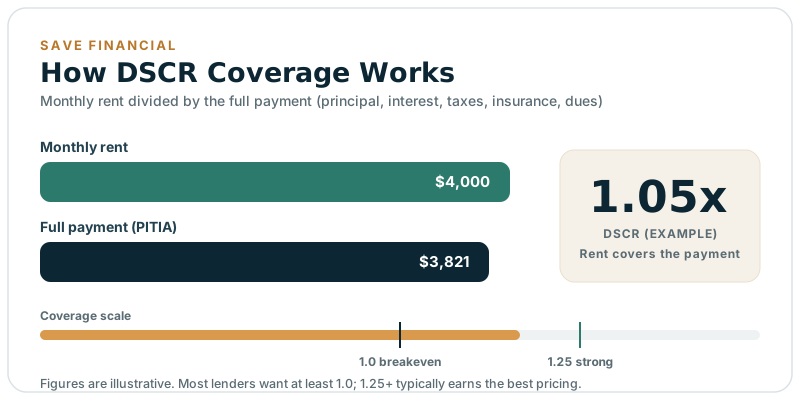
DSCR loans. These qualify on the property's rental cash flow instead of your personal income, with no tax returns and usually no limit on the number of properties. They're a favorite for portfolio investors and anyone closing in an LLC. Our DSCR loans guide covers the ratio math and requirements in detail.
Bank statement loans. Built for self-employed investors, these qualify on your bank deposits rather than tax returns, and they work for investment property as well as primary homes. See our bank statement loans guide for how the income is calculated.
Jumbo investment loans. For higher-value properties that exceed conforming limits, common in California's pricier markets. Stronger credit and larger reserves apply.
2 to 4 unit and small multifamily. Duplexes through fourplexes can be financed as investments, or with low-down FHA or VA financing if you live in one unit. The rental income from the other units can help you qualify.
Portfolio loans. For larger investors, a single loan can cover multiple properties, simplifying management and sometimes improving terms across the group.
Bridge and fix-and-flip loans. Short-term, business-purpose financing for buying and renovating, often based on the after-repair value of the property, with interest-only payments and a quick payoff once you sell or refinance. These carry higher rates and points but move fast.
Cash-out refinance and HELOC. Already own property? A cash-out refinance on an existing rental, or a home equity line on your primary residence, can fund the down payment on your next purchase.
With that many options, a few questions point you to the right one quickly.
Do you qualify on personal income? If your tax returns clearly show enough income and you're under the property limit, a conventional investment loan is usually the cheapest path.
Are you closing in an LLC? Conventional financing usually won't allow it. DSCR will, which makes it the common choice for entity buyers.
Are you self-employed with write-offs? A bank statement loan recognizes income your tax returns hide.
How many properties do you already finance? Past roughly ten conventional loans, DSCR or portfolio financing keeps you growing.
Are you holding or flipping? Buy-and-hold favors conventional, DSCR, or bank statement loans. A flip calls for short-term bridge or fix-and-flip financing.
We'll walk through these with you and match the deal to the loan, not the other way around.
Requirements vary by program, but investment loans share a few common threads.
Down payment. Typically 15 to 25 percent, more on some programs and property types. Investment loans almost always require more down than an owner-occupied purchase.
Credit score. Conventional investment loans generally start around 620 to 640, with non-QM programs in a similar range and better pricing at higher scores.
Cash reserves. Lenders usually want several months of payments in reserve, and the requirement grows with the number of properties you own.
Your own funds. Conventional investment loans generally require the down payment to be your own money rather than a gift, which is why investors often use a cash-out refinance or HELOC to fund it.
Rate. Investment loans price above owner-occupied loans, reflecting the added risk to the lender.
Documentation. Conventional needs tax returns and income docs. DSCR and bank statement programs replace those with property income or deposits.
Here's the honest part. California is expensive, and at today's prices and rates, a rental's rent often doesn't fully cover the payment and expenses, especially with a standard down payment. That doesn't mean the math never works. It means you build a strategy around it.
A larger down payment improves cash flow and helps the property qualify on programs that weigh rent against the payment. Short-term and vacation rentals, common along the coast and in tourist areas, can generate more income than a long-term lease. Adding an ADU to a property can create a second income stream, and California's ADU-friendly rules make that more feasible than in most states. And many California investors buy for appreciation and equity growth as much as monthly cash flow, accepting thin early returns in exchange for long-term gains in a supply-constrained market.
There's no single right answer. The strategy depends on the market, the property, and your goals, and a good lender helps you run those numbers before you commit.
California has some of the strongest tenant protections in the country, and they affect your returns. A statewide law caps annual rent increases and requires just cause for many evictions, and individual cities layer their own rent-control and tenant ordinances on top, with the specifics varying widely from one city to the next. Short-term rentals are also regulated locally, and some cities restrict or ban them outright.
None of this is a reason to avoid California real estate, but it's a reason to do your homework on the specific city before you buy. Factor the local rules into your income projections, and check the current ordinances or a qualified advisor rather than assuming. We'll make sure the financing fits, and we'll always encourage you to confirm the local landlord rules as part of your due diligence.
Investment property loans price above owner-occupied financing across the board. Your rate depends on the program, your credit, your down payment, the property type, and, for DSCR, the cash-flow ratio. Some non-QM and short-term programs include points and prepayment penalties, which we'll always flag.
Closing costs run in the usual California range, roughly 2 to 5 percent of the loan amount, covering the appraisal, title, escrow, and lender fees. On larger or multiple purchases, that adds up, so we give you a clear written estimate up front. Because investor pricing varies so much between programs and lenders, comparing them is where the real savings live.
The path depends a little on the program, but the shape is consistent.
Strategy and quote. You tell us the property, the expected rent, and your goals. We identify the programs that fit and quote them side by side.
Application. You provide the documents your program needs: tax returns for conventional, bank statements for a bank statement loan, or property and entity details for DSCR.
Appraisal. The appraiser confirms value, and for rentals, a market rent schedule.
Underwriting. The lender verifies your file. Income-based programs take longer here; cash-flow programs move faster.
Clear to close and funding. You satisfy the final conditions, sign, and the loan funds.
Timelines run from about three weeks on a clean DSCR file to 30 to 45 days on a conventional purchase.
Your financing needs change as your portfolio grows, and planning ahead keeps you moving. Early on, conventional investment loans give you the best rates while you qualify on income and stay under the financed-property limit. As you approach that limit, around ten conventional loans, DSCR financing keeps you buying without the cap, qualifying each property on its own cash flow. Larger investors often consolidate several properties under a single portfolio loan to simplify management. Reserves matter more as you scale, since lenders want more months of payments held back as your holdings grow. The smart move is to sequence your financing deliberately: use the cheapest qualifying option now, and keep your credit, reserves, and entity structure ready for the next purchase. We map this out with portfolio investors so each acquisition sets up the one after it.
A few errors cost investors money or deals.
Defaulting to one loan type. The cheapest loan for your last deal may not be right for this one. Match the loan to the property and your situation each time.
Ignoring reserves. Lenders want months of payments in reserve, and the requirement grows with your portfolio. Plan for it alongside the down payment.
Overlooking local rent rules. A property that pencils on paper can underperform once rent caps and tenant rules apply. Check the local ordinances first.
Skipping the cash-flow analysis. In California, run the numbers before you fall for a property, including taxes, insurance, vacancy, and management.
Taking the first quote. Investor pricing varies widely between programs and lenders. One quote tells you nothing about whether it's competitive.
What types of loans can I use for investment property in California? Conventional investment loans, DSCR loans, bank statement loans, jumbo loans, 2 to 4 unit and portfolio loans, and short-term bridge or fix-and-flip financing. The right one depends on how you qualify and your strategy.
How much do I need to put down on an investment property? Typically 15 to 25 percent, and sometimes more depending on the program and property type. Investment loans almost always require more down than an owner-occupied purchase.
Can I qualify without using my tax returns? Yes. DSCR loans qualify on the property's rental income, and bank statement loans qualify on your deposits, so neither requires tax returns. Conventional loans do require them.
What credit score do I need for an investment property loan? Conventional investment loans generally start around 620 to 640, with non-QM programs in a similar range. Higher scores earn better pricing.
Can I buy an investment property through an LLC? Yes, most often with a DSCR loan, which commonly allows closing in an entity. Conventional financing usually does not.
Do California rent-control laws affect my investment? They can. A statewide law caps many rent increases and requires just cause for many evictions, and cities add their own rules. Check the local ordinances for any property before you buy.
How many investment properties can I finance? Conventional guidelines limit most borrowers to around ten financed properties. DSCR and portfolio loans generally have no such cap, which is why portfolio investors rely on them.
Can I use my home equity to buy a rental? Yes. A cash-out refinance or a home equity line of credit on a property you already own can fund the down payment on your next purchase.
Financing investment property well means comparing options most lenders don't all offer. A bank pushes its own product. We compare conventional, DSCR, bank statement, jumbo, and portfolio programs across many lenders, then match your deal and your strategy to the one that fits. For an investor, that comparison is where returns are made or lost.
Our approach is education first. We run the numbers with you, explain the trade-offs between programs in plain language, and lay your options out side by side so you can decide without pressure. Responsible lending guides what we recommend, which means we'll steer you to the cheaper option when you qualify for it. You're welcome to verify our license on NMLS Consumer Access (NMLS #377740, DRE #01875766) before we begin.
Newport Beach (headquarters) Save Financial 4000 MacArthur Blvd, Suite 600 Newport Beach, CA 92660 (949) 379-5320
Marina del Rey Save Financial 13763 Fiji Way, Suite EU2 Marina del Rey, CA 90292 (310) 759-4757
The best time to line up financing is before you make an offer. Tell us about the property and your goals, and we'll compare your options, run the cash flow, and quote the programs that fit, all in plain numbers.
If you're buying or refinancing an investment property anywhere in California, reach out to Save Financial. As a California brokerage that works with investors across every loan type, we'll find the financing that fits this deal and your bigger plan. Call our Newport Beach office at (949) 379-5320 or request a quote to get started.
Loan programs, interest rates, fees, terms, and eligibility requirements are subject to change without notice and depend on borrower qualifications, property cash flow, and lender approval. Investment property loans are intended for business and investment purposes. This page is general information, not legal or tax advice; consult a qualified professional about local rental regulations. Save Financial is a California-licensed mortgage brokerage (NMLS #377740, DRE #01875766). Equal Housing Opportunity.
Save Financial is a California-licensed mortgage brokerage (NMLS #377740, DRE #01875766) with offices in Newport Beach and Marina del Rey. Call (888) 703-1840 or request your free rate quote. Rates and terms are subject to change and depend on borrower qualifications and lender approval. Equal Housing Opportunity.