
Conventional loans in California are the most common way people finance a home, and for good reason. They offer competitive rates, flexible terms, down payments as low as 3 percent, and mortgage insurance you can eventually remove, which sets them apart from FHA. They also work for primary homes, second homes, and investment properties, giving you more flexibility than government loans allow.

Save Financial is a California-licensed mortgage brokerage, and we help buyers weigh a conventional loan against FHA, VA, and other options every week. This guide explains how conventional loans work, the 2026 California limits, how to remove mortgage insurance, the difference between fixed and adjustable rates, and who these loans suit best.
A conventional loan is a mortgage that isn't insured or guaranteed by a government agency. Most conventional loans are conforming, meaning they meet the guidelines set by Fannie Mae and Freddie Mac, the two entities that buy mortgages on the secondary market. Those guidelines cover loan size, credit, down payment, and more, and conforming to them is what keeps rates competitive.
Because there's no government insurance behind them, conventional loans rely more on your credit and down payment than FHA or VA loans do. The flip side is real flexibility: you can use a conventional loan for nearly any property type and occupancy, and you can shed the mortgage insurance once you build equity. For borrowers with solid credit, conventional is often the cheapest option over time.
Conventional financing fits a clear set of buyers.
It's the strong choice for buyers with good credit, since conventional pricing rewards higher scores with better rates. It works well for anyone who wants to avoid permanent mortgage insurance, because conventional PMI comes off once you reach enough equity. It's the right tool for second homes and investment properties, which FHA and VA don't cover. And it suits buyers putting down 20 percent or more, who skip mortgage insurance entirely from day one.
If your credit is still recovering or your down payment is very small, an FHA loan may be more forgiving. We'll compare them honestly so you land on the cheapest loan you qualify for.
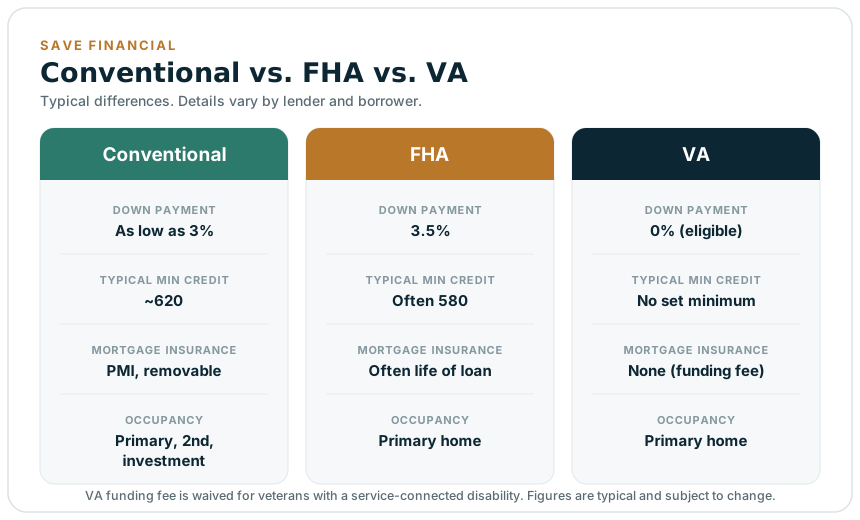
All three are excellent loans. The right one depends on your credit, your down payment, and your eligibility.
| Conventional | FHA | VA | |
|---|---|---|---|
| Down payment | As low as 3% | 3.5% | 0% |
| Minimum credit | Around 620 | 580 | No VA minimum |
| Mortgage insurance | PMI, removable at 20% equity | Often for the life of the loan | None |
| Occupancy | Primary, second, investment | Primary only | Primary only |
| Best for | Strong credit and flexibility | Lower credit or higher DTI | Eligible veterans |
The quick logic: VA wins for eligible veterans, hands down. FHA wins when your credit is lower or your debt-to-income is tight. Conventional wins when your credit is solid, because you keep your costs down and can drop the mortgage insurance later. Many buyers who start with FHA refinance into conventional once their equity and credit improve.
Conventional guidelines are set by Fannie Mae and Freddie Mac, with some lender overlays.
On credit, conventional loans generally start around a 620 score, and your rate improves as your score climbs, since conventional pricing is tiered by credit and down payment. The down payment ranges from as low as 3 percent for some first-time and moderate-income buyers, to 5 percent on standard loans, up to 20 percent to skip mortgage insurance. Lenders review your debt-to-income ratio, usually wanting it under about 45 to 50 percent, and you'll document income with tax returns and pay stubs, or with bank statements on a non-QM program if you're self-employed. Gift funds from family are allowed toward your down payment within program rules.
Conventional loans also offer the widest range of property types and occupancy, from a primary home to a vacation property to a rental, each with its own terms.
A lot of buyers assume conventional means a big down payment. It doesn't have to. Fannie Mae and Freddie Mac offer programs built for moderate-income and first-time buyers that allow as little as 3 percent down, often with reduced mortgage insurance costs compared to a standard low-down loan. These programs have income limits in many areas and sometimes ask for a short homebuyer education course, but they let buyers with good credit get into a home with a small down payment while keeping the conventional advantage of removable mortgage insurance. They can also pair with down payment assistance and gift funds to lower your cash even further. We'll check whether you qualify for one of these programs and compare it against FHA so you choose the lower-cost path.
This is conventional's quiet advantage over FHA, so it's worth understanding. If you put down less than 20 percent on a conventional loan, you'll pay private mortgage insurance, or PMI, as part of your monthly payment. Unlike FHA's mortgage insurance, conventional PMI doesn't last forever.
You can remove it a few ways. By law, PMI automatically falls off once your loan balance reaches 78 percent of the home's original value. You can also request cancellation earlier, once you reach 80 percent, if your payment history is good. And in a rising market like much of California, you may be able to request removal sooner by getting a new appraisal that shows your equity has grown to 20 percent through appreciation. That last point matters here, because California home values have a history of climbing, which can let you drop PMI faster than the amortization schedule alone would.
Put 20 percent down and you skip PMI entirely from the start. We'll show you the trade-off between a smaller down payment with PMI and a larger one without, in real numbers, so you can choose what fits your cash and your goals.
Conforming conventional loans have a size limit that varies by county based on local home prices. Here's where California stands for 2026.
| County tier | 2026 conforming limit (1-unit) | Examples |
|---|---|---|
| Baseline (most counties) | $832,750 | Many inland and lower-cost counties |
| High-balance (high-cost counties) | Up to $1,249,125 | Los Angeles, Orange, San Francisco, and other coastal metros |
A loan between the baseline and the high-balance ceiling is called a high-balance or super-conforming loan, and it usually carries a slightly higher rate than a baseline conforming loan. Borrow above the ceiling and you move into jumbo financing, which has its own guidelines. We confirm the exact limit for your county before you write an offer.
Conventional loans come in two flavors, and choosing between them comes down to how long you'll keep the loan and how you feel about your payment changing.
A fixed-rate loan keeps the same interest rate and principal-and-interest payment for the entire term. The 30-year fixed is the most popular mortgage in the country because it offers the lowest fixed payment and complete predictability. A 15-year fixed carries a higher monthly payment but a lower rate and far less total interest, which suits buyers who want to own free and clear sooner.
An adjustable-rate mortgage, or ARM, starts with a fixed rate for an initial period, often five, seven, or ten years, then adjusts periodically after that based on market rates. ARMs usually start with a lower rate than a comparable fixed loan, which can make sense if you expect to sell or refinance before the fixed period ends. The risk is that your rate and payment can rise once the adjustments begin. For most buyers planning to stay long term, the predictability of a fixed rate is worth it, but we'll walk through both so the choice fits your plans.
One of conventional financing's biggest advantages is reach. FHA and VA loans are for primary residences only, but a conventional loan can finance a second home or an investment property. The terms differ from a primary purchase, with larger down payments and slightly higher rates on non-owner-occupied loans, but the door is open. If you're buying a vacation place on the coast or a rental to build wealth, a conventional loan is often the starting point, and we'll compare it against investor-specific options like DSCR when that fits better.
Pros. Competitive rates for strong credit. Down payments as low as 3 percent. Mortgage insurance you can remove, unlike FHA. No upfront mortgage insurance premium. Works for primary, second, and investment properties. Flexible terms, fixed or adjustable.
Cons. Stricter credit and income standards than FHA or VA. Pricing tiered by credit and down payment, so a lower score costs you more. PMI applies until you reach 20 percent equity if you put less down. And conforming limits cap the loan size before you move into jumbo territory.
Your conventional costs depend on your down payment and credit. The down payment ranges from 3 to 20 percent or more. PMI, if you put less than 20 percent down, is built into your monthly payment until you remove it. Unlike FHA, there's no upfront mortgage insurance premium added to your loan. And closing costs run the usual California range of roughly 2 to 5 percent of the loan amount, sometimes offset by a seller or lender credit. We give you a clear written estimate so you see the full picture before you commit.
A conventional purchase follows the standard path. We start with a pre-approval, reviewing your income, assets, and credit and issuing a letter that shows what you can borrow. You find a home and make an offer, lock your rate, and we order the appraisal. The loan moves through processing and underwriting, where we verify your documents and the lender reviews everything. Once it's approved with conditions met, you get a clear-to-close, sign with a notary, and the loan funds.
Most conventional purchases close in about 30 to 45 days, and a clean file can move faster.
A few errors come up often.
Some buyers put down exactly enough to trigger PMI without realizing a slightly larger down payment would have avoided it, or that a slightly smaller one would have freed up cash for reserves. Others assume their PMI is permanent like FHA's, and never request removal once they hit 20 percent equity, paying for insurance they could have dropped. Some choose an ARM for the lower starting rate without planning for the adjustment, then get surprised when it resets. And many take the first quote, when conventional pricing varies between lenders and a comparison saves real money, especially since pricing is so sensitive to credit and down payment.
We help you avoid each of these by running your real numbers up front.
What credit score do I need for a conventional loan in California? Conventional loans generally start around a 620 score, with better rates at higher scores. Because pricing is tiered by credit and down payment, improving your score before applying can lower your rate.
How much down payment do I need for a conventional loan? As little as 3 percent for some first-time and moderate-income buyers, 5 percent on many standard loans, and 20 percent to avoid mortgage insurance entirely.
Can I remove PMI from a conventional loan? Yes. PMI automatically falls off at 78 percent of the original value, you can request cancellation at 80 percent, and in a rising market you may remove it sooner with a new appraisal showing 20 percent equity.
What are the 2026 conventional loan limits in California? The 2026 baseline conforming limit is $832,750 in most counties, rising to a high-balance ceiling of $1,249,125 in high-cost counties like Los Angeles and Orange. Loans above the ceiling are jumbo.
Is a conventional loan better than FHA? For strong credit, usually yes, because you can remove the mortgage insurance and often get a better rate. FHA tends to win for lower credit or a higher debt-to-income ratio. We compare both for you.
Can I use a conventional loan for an investment property? Yes. Conventional loans finance primary homes, second homes, and investment properties, unlike FHA and VA, which are for primary residences only.
Should I choose a fixed-rate or adjustable-rate loan? A fixed rate suits most buyers planning to stay long term, with a stable payment. An ARM can make sense if you expect to sell or refinance before the fixed period ends, since it often starts with a lower rate.
How long does a conventional loan take to close? Most conventional purchases close in about 30 to 45 days, with a clean file sometimes closing faster.
Conventional pricing is unusually sensitive to your credit score and down payment, and it varies between lenders. Two lenders can quote noticeably different rates on the same file. Shopping them is where strong-credit borrowers save the most, and that's exactly what a broker does. We compare conventional lenders across California, and just as important, we weigh conventional against FHA, VA, and jumbo so you end up with the cheapest loan you qualify for.
Our approach is education first. We explain PMI and the fixed-versus-ARM choice in plain language, lay your options out side by side, and let you decide without pressure. Responsible lending guides what we recommend. You're welcome to verify our license on NMLS Consumer Access (NMLS #377740, DRE #01875766) before we begin.
Newport Beach (headquarters) Save Financial 4000 MacArthur Blvd, Suite 600 Newport Beach, CA 92660 (949) 379-5320
Marina del Rey Save Financial 13763 Fiji Way, Suite EU2 Marina del Rey, CA 90292 (310) 759-4757
The best way to know whether a conventional loan fits is to compare it against your alternatives on your actual numbers. Tell us your credit, your down payment, and your goals, and we'll show you conventional alongside FHA and VA, with the real monthly cost of each.
If you're buying or refinancing anywhere in California, reach out to Save Financial. As a California brokerage that shops conventional loans across many lenders, we'll find the program and the terms that fit you best. Call our Newport Beach office at (949) 379-5320 or request your free pre-approval to get started.
Loan programs, interest rates, fees, terms, and eligibility requirements are subject to change without notice and depend on borrower qualifications and lender approval. Save Financial is a California-licensed mortgage brokerage (NMLS #377740, DRE #01875766). Equal Housing Opportunity.
Save Financial is a California-licensed mortgage brokerage (NMLS #377740, DRE #01875766) with offices in Newport Beach and Marina del Rey. Call (888) 703-1840 or request your free rate quote. Rates and terms are subject to change and depend on borrower qualifications and lender approval. Equal Housing Opportunity.