
DSCR loans in California give real estate investors a way to finance a rental property based on what the property earns, not what your tax returns say you make. No pay stubs, no W-2s, no debt-to-income math on your personal finances. If the rent covers the payment, you can usually qualify. That's the appeal, and for investors who own several properties or write off a lot of income, it's a big one.
Save Financial is a California-licensed mortgage brokerage, and we arrange DSCR financing through wholesale and non-QM lenders across the state. This guide explains how DSCR loans work, how the ratio is calculated, what you'll need to qualify, how they compare to a conventional investment loan, and the California-specific catch worth understanding before you count on one.
DSCR stands for debt service coverage ratio. A DSCR loan qualifies you on the property's cash flow instead of your personal income. The lender looks at whether the rent covers the mortgage payment, and if it does, your personal income, employment, and debt-to-income ratio mostly drop out of the picture.
That's a different world from a conventional loan, where the underwriter pores over your tax returns, pay stubs, and every monthly obligation. With a DSCR loan, the property carries the qualification. This is why investors love them, especially self-employed owners whose tax returns understate their real earnings, and portfolio investors who've hit the limit on how many conventional loans they can carry.
You can typically close a DSCR loan in the name of an LLC, which conventional financing usually won't allow. For investors who hold property in an entity for liability or tax reasons, that alone can make DSCR the right tool.
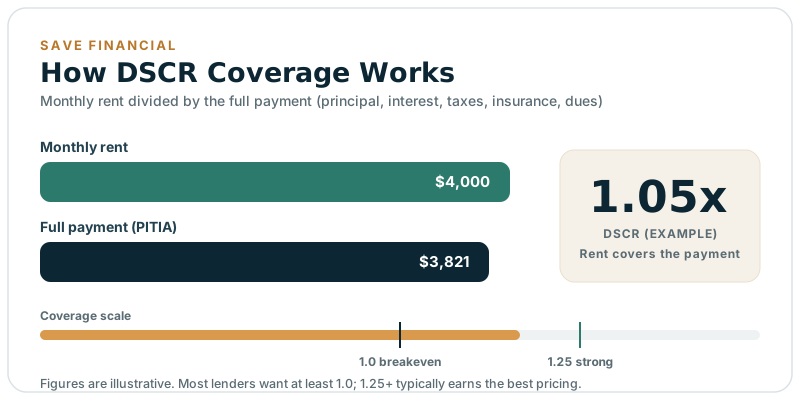
The math is simple, and understanding it tells you instantly whether a property is likely to qualify.
DSCR = monthly rental income / monthly PITIA
PITIA is the full housing payment: principal, interest, taxes, insurance, and any homeowners association dues. You divide the rent by that payment to get the ratio.
A few quick examples make it concrete:
Here's a worked example. Say a rental brings in $4,000 a month, and the full PITIA payment is $3,500. Divide $4,000 by $3,500 and you get a DSCR of about 1.14. The property earns 14 percent more than the payment. A lender that requires a 1.0 minimum approves it comfortably, while a lender that wants 1.25 would not, at least not at that loan amount.
Most lenders use market rent from the appraisal, or your actual lease if it's higher or lower, to set the rental income figure. We'll run your target property's numbers before you make an offer so you know where the ratio lands.
DSCR programs vary by lender, which is exactly why shopping them matters. These are the typical ranges you'll see.
Minimum DSCR. Many lenders want a ratio of 1.0 or higher, and some price best at 1.25 and up. Others will go below 1.0, even down to a no-ratio program, in exchange for a larger down payment and a higher rate.
Down payment and LTV. Most DSCR loans cap out around 75 to 80 percent loan-to-value, so plan on 20 to 25 percent down. A bigger down payment improves your ratio, since it lowers the payment.
Credit score. Programs generally start somewhere in the low-to-mid 600s, with better pricing as your score climbs.
Cash reserves. Lenders usually want a few months of the full payment held in reserve after closing, often three to six months.
Property types. Single-family rentals, 2 to 4 unit properties, condos, and in many cases short-term and vacation rentals all qualify. Some lenders finance small multifamily beyond four units.
Entity vesting. Closing in an LLC is common and usually allowed, which is a meaningful advantage over conventional financing.
One more point investors appreciate: DSCR loans generally don't cap the number of properties you can finance, while conventional guidelines limit most borrowers to around ten financed properties. For a growing portfolio, that ceiling matters.
Here's the honest part most pages skip. California is an expensive state, and in many markets the rent simply doesn't cover the payment at today's prices and rates. That pushes the DSCR below 1.0, which can put a property out of reach for programs that require a ratio of 1.0 or more.
It doesn't mean DSCR is off the table in California. It means you plan for it. A few approaches work:
A larger down payment lowers the monthly payment and lifts the ratio, sometimes enough to clear the threshold. Short-term and vacation rentals, common along the California coast and in tourist areas, can generate more income than a long-term lease, which raises the DSCR if your lender accepts short-term rental income. And some investors lean on no-ratio or sub-1.0 programs, accepting a higher rate and bigger down payment to buy in a market they expect to appreciate.
The right move depends on your goals, the property, and the market. Because we shop many DSCR lenders, we can find the one whose ratio requirements and income treatment fit your specific deal rather than forcing your deal to fit one lender's box.
Both finance rentals, but they qualify you in opposite ways.
| DSCR loan | Conventional investment loan | |
|---|---|---|
| Qualifies on | Property cash flow | Your personal income and DTI |
| Tax returns required | No | Yes |
| Property limit | Generally none | About 10 financed properties |
| Close in an LLC | Usually yes | Usually no |
| Typical down payment | 20 to 25% | 15 to 25% |
| Rate | Higher | Lower |
| Prepayment penalty | Often yes | No |
A conventional investment loan usually offers a lower rate and no prepayment penalty, so it's often the better choice if you qualify on personal income and haven't hit the property limit. DSCR shines when your tax returns don't tell the full story, you're buying through an entity, or you've outgrown conventional limits.
Pros. No personal income or employment verification. No limit on the number of properties. Closing in an LLC. Faster, simpler documentation. Strong fit for self-employed and portfolio investors.
Cons. Higher rates than conventional. Larger down payments. Cash reserves required. And many DSCR loans carry a prepayment penalty, meaning you'll owe a fee if you pay off or refinance the loan within the first few years. That penalty structure varies by lender and is negotiable on some programs, so it's worth understanding before you lock. We'll always flag the prepayment terms so they don't surprise you down the road.
DSCR loans price higher than conventional financing because they're non-QM and the lender is taking the property's word over yours. Expect a rate above a comparable owner-occupied or conventional investment loan, with pricing driven by your DSCR, credit score, down payment, and the property type. You may also see points and the prepayment penalty discussed above.
Closing costs run in the same general range as other California loans, roughly 2 to 5 percent of the loan amount, covering the appraisal, title, escrow, and lender fees. We provide a clear written estimate up front. Because DSCR pricing varies widely between lenders, comparing several is where an investor saves real money, and that comparison is exactly what a broker does for you.
DSCR loans aren't only for purchases. Investors use them to refinance a rental into better terms, or to pull equity out with a cash-out refinance and roll it into the next property. The same rules apply: the property's cash flow drives qualification, not your personal income, and you can often keep the property in an LLC. A cash-out DSCR refinance can be a clean way to recycle equity across a growing portfolio without touching your tax returns. We'll run the numbers on your existing rental and show you what a refinance or cash-out would look like alongside simply leaving the current loan in place.
DSCR financing fits a specific investor profile, and fits it well.
Self-employed investors and business owners whose tax returns understate their income after write-offs.
Portfolio investors who've hit or are approaching the conventional financed-property limit.
Investors using an LLC for liability or tax planning who need to close in the entity.
Buyers of short-term and vacation rentals who want to qualify on the property's stronger income.
Anyone who values speed and simpler paperwork over the lowest possible rate.
If you're a W-2 buyer purchasing your first rental and you qualify on personal income, a conventional investment loan may serve you better. We'll tell you honestly which one fits.
A DSCR loan moves faster than a conventional file because there's less personal documentation to chase.
Quote and pre-qualification. You tell us the property and the expected rent. We run the DSCR and quote programs that fit, including the rate, down payment, and any prepayment terms.
Application. You provide property details, your entity documents if you're closing in an LLC, credit authorization, and proof of funds for the down payment and reserves.
Appraisal with rent schedule. The appraiser confirms the value and the market rent, which sets your DSCR.
Underwriting. The lender verifies the ratio, your credit, reserves, and the property. Because there's no personal income review, this stage is usually quicker.
Clear to close and funding. You satisfy the final conditions, sign, and the loan funds.
Many DSCR loans close in roughly 21 to 35 days, depending on the lender and the appraisal timeline.
A few errors trip up DSCR borrowers.
Ignoring the prepayment penalty. If you plan to sell or refinance soon, a penalty can cost you. Know the terms before you lock.
Assuming the rent will cover the payment. In much of California it won't at full price, so run the DSCR before you fall for a property, not after.
Taking the first DSCR quote. Non-QM pricing varies a lot between lenders. One quote tells you nothing about whether it's competitive.
Forgetting reserves. Buyers focus on the down payment and overlook the months of payments lenders want in reserve. Plan for both.
Using DSCR when conventional would be cheaper. If you qualify on income and haven't hit the property limit, conventional often wins on rate. We'll compare both.
What is a DSCR loan? A DSCR loan is a mortgage for investment property that qualifies you on the property's rental income instead of your personal income. If the rent covers the payment, you can usually qualify, with no tax returns or employment verification required.
How is DSCR calculated? Divide the monthly rental income by the monthly PITIA payment, which is principal, interest, taxes, insurance, and HOA dues. A ratio of 1.0 means rent covers the payment exactly, and 1.25 means it covers it with a 25 percent cushion.
What DSCR do I need to qualify in California? Many lenders want a ratio of 1.0 or higher, and some price best at 1.25 and up. Others allow ratios below 1.0, even no-ratio programs, in exchange for a larger down payment and a higher rate.
Can I get a DSCR loan with a low ratio in California? Yes, often. Because California prices can push the ratio below 1.0, lenders offer sub-1.0 and no-ratio programs, and a larger down payment or short-term rental income can lift the ratio. We match your deal to the right lender.
Do DSCR loans require tax returns? No. That's the core benefit. You qualify on the property's cash flow, so there's no personal income, employment, or debt-to-income review.
Can I close a DSCR loan in an LLC? Usually yes. DSCR loans commonly allow closing in an entity, which is a key advantage for investors holding property in an LLC.
Do DSCR loans have prepayment penalties? Many do. The penalty applies if you pay off or refinance within the first few years, and the structure varies by lender. We always flag the prepayment terms before you lock.
Are DSCR rates higher than conventional? Yes, generally. DSCR loans are non-QM and price above conventional financing, with the rate driven by your DSCR, credit, down payment, and property type.
Can I use a DSCR loan for a short-term or vacation rental? Many lenders allow it, sometimes using short-term rental income to qualify, which can raise your DSCR. The treatment varies by lender, so we match you to one that fits your strategy.
DSCR pricing and guidelines vary more than almost any other loan type, because every non-QM lender sets its own rules on minimum ratios, income treatment, reserves, and prepayment penalties. Shopping them is where the real savings live, and that's exactly what a broker does. We compare DSCR lenders across California and match your deal to the one whose box your property actually fits.
Our approach is education first. We run your DSCR before you commit, explain the prepayment terms in plain language, and lay your options out side by side so you can decide without pressure. Responsible lending guides what we recommend, which means we'll point you to a conventional loan instead when it's the better deal. You're welcome to verify our license on NMLS Consumer Access (NMLS #377740, DRE #01875766) before we begin.
Newport Beach (headquarters) Save Financial 4000 MacArthur Blvd, Suite 600 Newport Beach, CA 92660 (949) 379-5320
Marina del Rey Save Financial 13763 Fiji Way, Suite EU2 Marina del Rey, CA 90292 (310) 759-4757
The fastest way to know whether a DSCR loan works for your next purchase is to run the ratio. Send us the property and the expected rent, and we'll calculate the DSCR, quote programs that fit, and lay out the rate, down payment, and prepayment terms in plain numbers.
If you're financing a rental anywhere in California, reach out to Save Financial. As a California brokerage that arranges DSCR loans across many lenders, we'll find the program that fits your deal and your portfolio. Call our Newport Beach office at (949) 379-5320 or request a quote to get started.
Loan programs, interest rates, fees, terms, and eligibility requirements are subject to change without notice and depend on borrower qualifications, property cash flow, and lender approval. DSCR loans are intended for business and investment purposes. Save Financial is a California-licensed mortgage brokerage (NMLS #377740, DRE #01875766). Equal Housing Opportunity.
Save Financial is a California-licensed mortgage brokerage (NMLS #377740, DRE #01875766) with offices in Newport Beach and Marina del Rey. Call (888) 703-1840 or request your free rate quote. Rates and terms are subject to change and depend on borrower qualifications and lender approval. Equal Housing Opportunity.